Home
» Sleep disorders
»
Snoring or Breathing Pauses? When to Seek a Sleep Evaluation
Snoring or Breathing Pauses? When to Seek a Sleep Evaluation
An updated American Academy of Sleep Medicine (AASM) position statement on home sleep apnea testing says a medical provider must decide whether a home test is appropriate and review its results; a consumer device or automatic score is not a diagnosis. A small NHLBI-described study also found that the loudest snoring does not necessarily mark the most severe breathing obstruction. For someone deciding what to do, the practical point is simple: judge the pattern and daytime effects, not the volume alone.
Ordinary snoring is sound from vibrating tissue as air moves through a narrowed upper airway. A repeated pattern of snoring, a quiet pause, then a snort, gasp, or choking breath is more concerning for sleep-disordered breathing. It still does not prove a diagnosis. A clinician uses a sleep evaluation and, when indicated, a sleep study to determine what is happening.
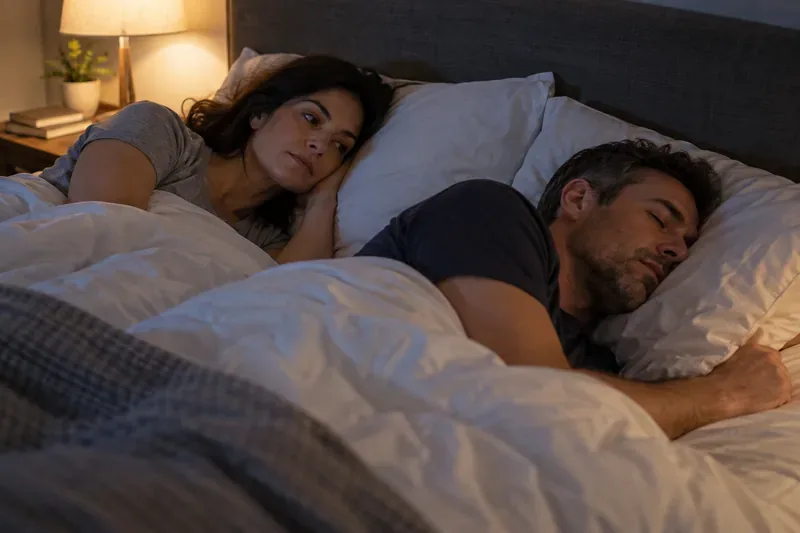
A bed partner may notice snoring or gasping that the sleeper does not remember, but listening alone cannot diagnose a sleep disorder.
What can the sound pattern tell you?
Snoring by itself is common and nonspecific. It may come and go with a stuffy nose, sleeping on the back, alcohol near bedtime, or other factors that affect the upper airway. MedlinePlus notes that back-sleeping and alcohol or sleepy medicines near bedtime can worsen symptoms for some people. Some people snore without having obstructive sleep apnea (OSA), and some people with OSA do not fit the stereotype of an extremely loud snorer. A quieter night or a change in position does not rule out a breathing disorder.
Repeated pauses deserve a closer look. A bed partner may notice noisy breathing stop for a stretch, followed by a snort, gasp, or abrupt restart. The sleeper may not remember waking. Repeated gasping or choking, restless sleep, or witnessed pauses—especially along with daytime symptoms—are good reasons to contact a health care provider. NHLBI lists breathing that starts and stops, frequent loud snoring, and gasping for air among symptoms to discuss.
Volume alone cannot sort the two reliably. In a 2024 NHLBI report on a small study involving 40 people with suspected or diagnosed sleep apnea, snore loudness varied with both breathing effort and airway obstruction. The quietest intervals in that study occurred during episodes of apnea. This does not mean a quiet sleeper has apnea; it means neither a loud snore nor silence gives a dependable measure of severity by itself. Avoid using “not that loud” as reassurance when someone has seen repeated pauses.
Which signs make a sleep evaluation more worthwhile?
Book a routine appointment with a primary care clinician or sleep specialist if a partner repeatedly observes pauses, gasping, or choking, even if the sleeper feels mostly fine. Evaluation is also reasonable for persistent loud snoring combined with unrefreshing sleep, strong daytime sleepiness, morning headaches, dry mouth, difficulty concentrating, or frequent waking. A clinician can ask about symptoms and health history, examine the airway, and decide whether testing is appropriate. Symptoms overlap with other causes of poor sleep, so a list of signs is not a self-diagnosis.
Repeated pauses or gasping: arrange a clinical evaluation rather than waiting for the sound to get louder.
Snoring plus daytime impairment: mention sleepiness, trouble focusing, or dozing during ordinary activities; these details can change the evaluation.
Snoring alone with no other concern: consider an appointment if it is persistent, disruptive, or worrying. A clinician can help weigh the pattern and other risk factors; a single sound cannot establish OSA.
Sleepiness while driving or operating equipment: do not drive or operate machinery while struggling to stay awake. Arrange a safer ride and contact a clinician promptly. Sleep apnea and other sleep problems can impair attention and reaction time.
Risk factors such as obesity, airway anatomy, some medical conditions, and certain medications can affect the likelihood of OSA, but they do not determine a person’s diagnosis. People without familiar risk factors can still have sleep-disordered breathing. A clinician needs the whole history, not just body size, age, sex, or a phone recording.
How do home testing and an in-lab study compare?
Testing is not a do-it-yourself first step. AASM’s adult diagnostic-testing guideline says diagnosis should follow a medical evaluation, and questionnaires or prediction scores should not be used by themselves to diagnose OSA. If symptoms suggest a problem, ask the clinician which route fits the person’s health and circumstances.
Option
Often fits
Practical tradeoff
Home sleep apnea test (HSAT)
An uncomplicated adult with symptoms and clinical risk for moderate-to-severe OSA, when a provider selects this test.
It is done at home, but it is still a medical test. A provider must order it and arrange review of the data. A negative, inconclusive, or technically inadequate home test may need follow-up polysomnography.
In-lab polysomnography (PSG)
People for whom a broader evaluation is needed, or who have certain complicating health conditions.
It usually means sleeping overnight in a sleep center with sensors. It records several signals, including brain activity, heart rate, breathing, oxygen, and movement, and is the standard diagnostic test when OSA is a concern.
AASM recommends in-lab polysomnography rather than HSAT for people with significant heart or lung disease, possible respiratory muscle weakness, suspected sleep-related hypoventilation, chronic opioid use, a history of stroke, or severe insomnia. These factors do not mean a person has OSA; they affect which test may be reliable and appropriate. If a home test is negative but the symptoms or clinical concern remain, ask whether an in-lab study is the next step. The choice is about clinical fit, not which test sounds more convenient in the abstract.
NHLBI explains what sleep studies measure and that the clinician determines whether testing should happen at home or in a sleep center. In-lab sensors can gather broader sleep and breathing information, while home apnea tests are intended for selected patients and do not replace evaluation. The AASM position statement also warns against treating automatically scored home-test results as a stand-alone diagnosis.
What information should you bring?
A short, factual sleep log can help a visit without turning a partner into a monitor. For several nights, note when snoring happens, whether you saw a pause followed by a gasp or snort, sleep position if obvious, and any daytime effects the sleeper reports. Write down medications that may affect sleep and relevant health conditions. Do not try to count breaths, estimate oxygen levels, or infer how long an episode lasted; observation at home is imprecise.
If both people are comfortable, a brief audio or video clip may help explain what the partner means by “snoring,” but it cannot confirm or exclude apnea. Keep any recording private and share it only with the person’s consent. A questionnaire, smartwatch alert, microphone app, or home oxygen reading can be a conversation starter at most—not a substitute for a provider-directed test.
When is it urgent?
Repeated breathing pauses during sleep call for timely clinical attention, but they are not the same as an awake emergency. Call emergency services for severe trouble breathing while awake, blue or gray lips, inability to wake someone normally, or another immediate medical crisis. Separately, if sleepiness makes driving unsafe, stop driving and seek prompt clinical advice. Do not wait for an appointment to address an immediate safety risk.
Choose the next step by the pattern
Mostly occasional snoring, no witnessed pauses, and no daytime problems: note when it occurs and discuss it at a routine visit if it persists or disrupts sleep. Common triggers may be relevant, but they do not prove the cause.
Repeated pauses, gasps, or choking: arrange a sleep evaluation, even if the sleeper is unaware of the events or the snoring is not especially loud.
Snoring plus strong sleepiness, morning headaches, or concentration trouble: make an appointment and describe both nighttime observations and daytime effects.
Considering an at-home gadget or test: ask a clinician first. A medical-grade HSAT is ordered for selected adults and interpreted as part of a clinical evaluation; consumer scores alone cannot diagnose OSA.
The best outcome is not a label based on a sound clip. It is a clear answer about whether testing is appropriate, a reliable interpretation of the result, and a plan that matches the person’s symptoms and health. If the first test does not fit the observations, ask what follow-up is reasonable rather than assuming the issue has been ruled out.
Sources and review note
Reviewed September 30, 2026, using current NHLBI sleep apnea information and the AASM’s home-testing position statement (page dated May 1, 2025), alongside AASM’s adult diagnostic-testing guideline. The clinical guideline specifies when home testing versus polysomnography is appropriate and cautions that a negative or inadequate home test may need in-lab follow-up. This article is general education, not a diagnosis or individualized medical advice.