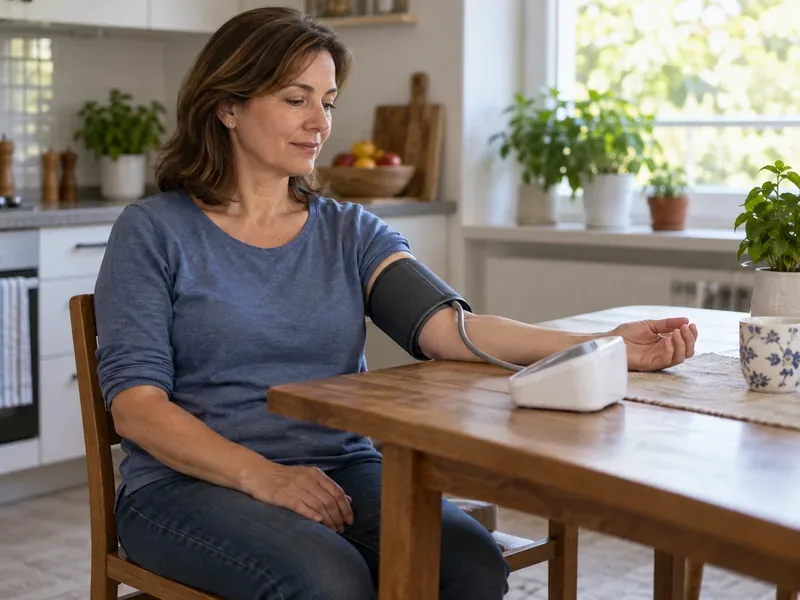
If your home blood pressure readings seem higher on cold mornings or vary from day to day, record the conditions around each measurement. A simple note of room temperature and seated rest time helps you and your clinician see whether readings were taken under similar conditions. It does not adjust a reading or diagnose the cause. This guide is for people who monitor blood pressure at home and want a more useful log.
Prerequisites
- Tools: A home blood pressure log (paper or digital), a pen or device, an upper-arm blood pressure monitor with a correctly sized cuff, and a room thermometer.
- Estimated time: About 8–10 minutes per session, including the recommended quiet rest and two readings; actual time varies by device and routine.
- Difficulty: Easy.
Use the measurement schedule your care team recommended. The American Heart Association advises taking two readings one minute apart and recording both. A room-temperature note is extra context, not a substitute for correct technique.
Step 1: Choose a consistent place and time
Use the same quiet room and, when practical, measure at similar times each day. Follow your clinician’s instructions about frequency and medication timing. Keep the thermometer in the room where you measure, away from a heater, sunny window, or draft; those locations may not reflect the air around your chair. You do not need a specialized thermometer or a specific target temperature for this log.
Step 2: Note the room temperature before you sit
Read the thermometer and enter the value in degrees Fahrenheit or Celsius, labeling the unit. Record it before the measurement so you do not have to get up during the rest period. If the thermometer is unavailable, write “not recorded” instead of guessing. A useful log column is Room temperature (°F/°C).
Step 3: Start a timer and rest quietly for five minutes
Sit in a comfortable chair with your back supported, feet flat on the floor, and legs uncrossed. Set a timer for at least five minutes. Stay quiet and avoid phone calls or conversation. Record the actual rest time, such as “5 min” or “7 min,” in a separate column. Rest time means the quiet seated period immediately before the first reading, not the time since waking or arriving home.
Step 4: Measure and record both readings
Place the cuff on bare skin as directed by the monitor instructions. Support your arm so the cuff is at heart level. Do not talk or move during the measurement. Take a second reading one minute after the first, unless your care team has given you a different plan. Record each result, its time, and the room temperature and rest time for that session. Don’t select only the lower reading or erase an unexpected one; preserving both results gives your clinician the full picture.
Step 5: Add brief context and review patterns
If the room felt unusually chilly, you were shivering, or you had just come in from outdoors, add a short note. Keep the note factual: for example, “room felt cold; just came inside.” Do not repeatedly retake measurements to chase a preferred number. Over time, compare readings taken under similar conditions and share the complete log with your care team. A 2025 study of older adults in Japan found an association between lower indoor temperature and higher morning and evening home readings. That finding does not predict an individual’s result or establish a temperature threshold for home measurements; it supports treating temperature as contextual information, not as a correction factor. See the study abstract indexed by the National Library of Medicine.
Worked example
Morning, 7:10 a.m.: Room temperature 66°F; seated rest 5 minutes; reading 1, 138/84 mm Hg; reading 2, 134/82 mm Hg; note: “room felt cool.” This entry tells the clinician both results and the conditions. It does not mean the second number is the only valid one, nor does it establish that the cool room caused the difference.
For consistent technique, CDC guidance recommends sitting with back supported for at least five minutes, feet flat, legs uncrossed, arm supported at chest height, and no talking during the reading. The American Heart Association also recommends avoiding smoking, caffeine, and exercise for 30 minutes beforehand, using a bare arm, and taking two readings one minute apart. Follow any different instructions from your own care team. CDC: Measuring Your Blood Pressure; American Heart Association: Home Blood Pressure Monitoring.
Troubleshooting
The thermometer reading changes or seems implausible
Move it away from direct sun, vents, radiators, and exterior doors, then allow it to settle according to its instructions. Record the value and where the thermometer was placed. If you cannot get a dependable reading, leave temperature blank rather than estimating.
You forgot to time the rest period
Record “rest time not timed.” Resume timing at the next session. Do not invent a duration or delay necessary care while trying to recreate the conditions.
Readings remain high or differ a lot
Check cuff fit, body position, and the monitor instructions; bring the monitor and log to your appointment so a clinician can review your technique. Contact your care team about repeated high readings and do not change medication based only on a log entry. If a reading is higher than 180 systolic and/or 120 diastolic, wait at least one minute and repeat it. If it remains that high, contact a health professional promptly. Call 911 for a reading in that range with chest pain, shortness of breath, back pain, weakness, numbness, vision changes, or trouble speaking. AHA: When to Call 911 About High Blood Pressure.
FAQ
Does a cold room raise blood pressure?
Research has linked lower indoor temperatures with higher average home readings in some populations, but it cannot tell what caused one person’s reading. Log the temperature and discuss persistent changes with your clinician.
How long should I rest before a home blood pressure reading?
CDC and AHA instructions recommend at least five minutes of quiet seated rest before measuring. Follow your care team’s specific directions if they differ.
Should I warm the room before measuring?
Measure in a comfortable setting when possible and use a consistent routine. There is no universal room-temperature adjustment to apply to your result. Record unusually cold conditions and ask your clinician how to interpret your readings.