Home
» Blood pressure
»
Why Blood Pressure Readings Differ Between Arms or Change Within Minutes
Why Blood Pressure Readings Differ Between Arms or Change Within Minutes
Blood pressure is not a fixed number. A small difference between arms or between readings taken a few minutes apart is common, and it often reflects normal short-term variation or how the cuff was used. The useful goal is a repeatable set of readings taken under similar conditions—not identical numbers every time. A single home reading cannot diagnose high blood pressure or explain why the numbers differ.
Repeatedly large differences between arms deserve a careful recheck and may be worth discussing with a clinician. So can readings that remain unusually high or low. The way to judge the result is to standardize the setup, record readings from the same arm, and look for a pattern over time.
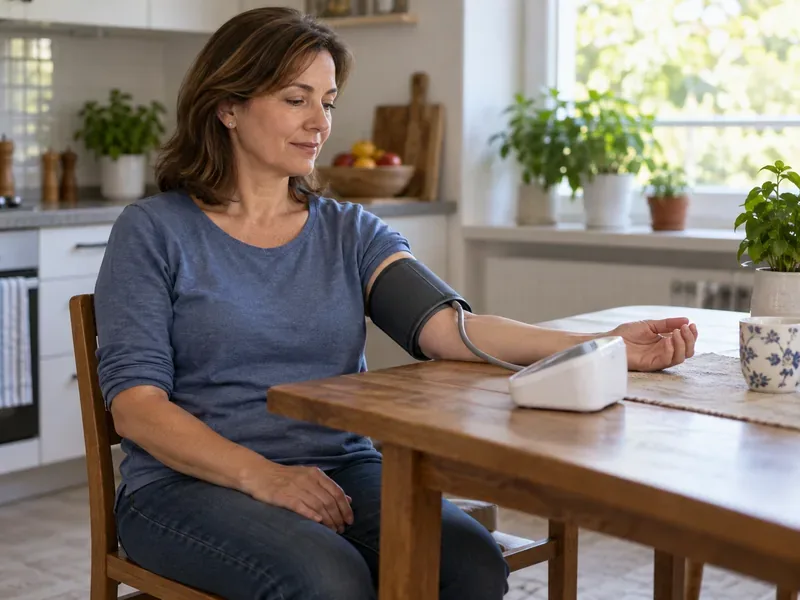
A seated person rests with an upper-arm cuff in place and forearm supported while taking a home blood-pressure reading.
Why can the numbers differ between arms?
Blood pressure cuffs measure pressure in an artery at a particular moment. Readings from the right and left arm are therefore not always identical. The difference may be small and inconsistent, especially if the two readings are taken one after the other rather than at exactly the same time. A little movement, talking, a different arm position, or a cuff that fits differently can make the comparison less reliable.
Sometimes a difference persists when the measurements are repeated correctly. That can reflect a real difference in blood flow or the arteries supplying the arms, among other possibilities. The number alone does not identify the cause. NICE guidance recommends repeating measurements if the difference between arms is more than 15 mm Hg; if it remains above that level on the second check, use the arm with the higher reading for later measurements. This is a measurement and follow-up rule, not a diagnosis.
For home monitoring, the American Heart Association says most people do not have a large difference between arms and advises using a consistent setup. If no clinician has told you which arm to use, ask them to compare both arms at a visit. If a meaningful difference persists, keep using the higher-reading arm unless your clinician gives different advice. Do not keep switching arms to find the lower number.
Why can blood pressure change within minutes?
Blood pressure rises and falls as the body responds to activity, stress, breathing, and other moment-to-moment changes. A reading taken just after walking across the room may differ from one taken after sitting quietly. Anxiety about a number can also affect the next reading. These short-term shifts are not, by themselves, proof that a person has hypertension.
Measurement conditions can create differences that look like a change in blood pressure. Common sources include:
Taking a reading soon after exercise, smoking, or caffeine. The AHA advises avoiding these for at least 30 minutes before a measurement.
Having a full bladder, talking, texting, or moving during the reading.
Sitting with legs crossed, feet unsupported, or back unsupported.
Letting the arm hang below heart level, or holding it up without support.
Putting the cuff over clothing, positioning it incorrectly, or using a cuff that does not fit the arm.
Comparing an upper-arm monitor with a wrist monitor, or using two different devices.
Even when the setup is good, readings may vary. A blood-pressure monitor captures a brief moment; a log taken over time is more informative than one isolated result.
How to get a more dependable home reading
Use a suitable device. Choose an independently validated automatic upper-arm monitor with a cuff sized for your measured arm circumference. Wrist and finger devices are less reliable for most people. Bring the device to an appointment so a clinician can check its fit and compare its readings with office equipment.
Prepare consistently. For 30 minutes beforehand, avoid exercise, smoking, and caffeine. Empty your bladder. Sit quietly for at least five minutes before measuring. Do not talk or use your phone.
Set your posture. Sit with your back supported, feet flat on the floor, and legs uncrossed. Place the cuff on bare skin. Rest your arm on a table or other support so the cuff is at about heart level; do not hold the arm up yourself.
Take two readings. Follow the monitor instructions and take two measurements one minute apart. Record both, the time, and which arm you used. If your clinician has identified a higher-reading arm, use that same arm for subsequent checks.
Look at the record, not just the latest number. Measure at the times and for the number of days your clinician recommends. Note relevant circumstances, such as recent activity or symptoms, instead of repeatedly checking every few minutes. If results remain inconsistent, ask for your monitor and technique to be checked.
These steps improve consistency; they cannot guarantee that every number will match or replace a clinical assessment. A clinician may recommend repeat office measurements, home monitoring, or 24-hour ambulatory monitoring, which records readings while you go about a usual day and during sleep.
What should you do about a difference between arms?
What you notice
Practical next step
The arms differ slightly, but the gap changes from one attempt to another.
Check your posture, cuff fit, and rest period. Repeat calmly with the same device and avoid comparing readings taken under different conditions.
The systolic reading (top number) remains more than 15 mm Hg higher in one arm when repeated.
Tell a clinician and use the higher-reading arm for later measurements, following the NICE approach. A clinician can decide whether further assessment is needed.
Readings shift up or down over several minutes.
Record the time and circumstances. Take two readings one minute apart after quiet rest, rather than repeatedly cycling the cuff. Discuss a persistent pattern with a health professional.
Your home readings and clinic readings differ consistently.
Bring your monitor and log to an appointment. Home or ambulatory monitoring can help a clinician understand whether the difference relates to setting, technique, or a sustained blood-pressure pattern.
When is a difference a red flag?
A persistent arm-to-arm gap is not an emergency by itself, but it should not be dismissed if it is repeatedly large under consistent measurement conditions. Seek emergency care for sudden severe chest or back pain, fainting, shortness of breath, new weakness or numbness, trouble speaking, or sudden vision changes—especially if these occur with a very high reading. Do not wait to see whether a concerning symptom resolves just because a later cuff reading is lower.
If a reading is higher than 180 systolic and/or 120 diastolic, the AHA advises waiting at least one minute and measuring again. If it remains that high and you have chest pain, shortness of breath, back pain, numbness, weakness, a change in vision, or difficulty speaking, call 911. If the repeat reading remains this high without those symptoms, contact a health professional immediately for instructions. Pregnancy and the period after birth have distinct blood-pressure risks and thresholds; contact your maternity care team promptly about repeated high readings or concerning symptoms.
What a home reading can—and cannot—tell you
A well-taken reading can help track blood pressure and show whether a pattern is changing. It cannot reveal by itself why the pressure changed, establish a diagnosis, or determine whether medication should be started, stopped, or changed. Do not skip a prescribed dose to influence a measurement. Share your readings and symptoms with your care team, and ask whether your device, arm choice, or monitoring schedule needs adjustment.
Guidance checked October 1, 2026. The arm-difference threshold described here comes from NICE guideline NG136, a United Kingdom guideline; local clinical guidance can differ. Home-measurement and emergency advice reflects current American Heart Association patient guidance. This article is educational and does not diagnose an individual.