Home
» Nutrition
»
Halloween Candy and Food Allergies: How to Read Labels and Plan Safer Treats
Halloween Candy and Food Allergies: How to Read Labels and Plan Safer Treats
At Halloween, a familiar candy may come in a miniature wrapper with a different recipe, a missing ingredient panel, or a cross-contact warning you have not seen before. For a child with a diagnosed food allergy, the useful question is not whether a treat looks safe, but whether its exact package and the child’s medical plan support eating it. A few repeatable checks can make trick-or-treating, classroom parties, and handing out candy more predictable.
Which part of a candy label should I check first?
Start with the ingredient list on the exact package, then read any separate “Contains” statement. In the United States, packaged foods regulated by the Food and Drug Administration must identify the food source of the nine major allergens when they are used as ingredients: milk, egg, fish, Crustacean shellfish, tree nuts, peanuts, wheat, soybeans, and sesame. The source may appear in parentheses after an ingredient—such as “whey (milk)”—or in a “Contains” statement. A “Contains” box is useful, but it is not a substitute for reading the full ingredient list.
Check for the child’s specific allergens, not just a “top allergen” summary. A child may react to an ingredient outside the federally defined nine, and a product that avoids one allergen may still contain another. Do not infer safety from color, flavor, a familiar brand, or a front-of-package claim. If the label uses an ingredient name you do not understand, or you cannot tell whether it contains the child’s allergen, set it aside and check with the manufacturer or the child’s allergist rather than guessing.
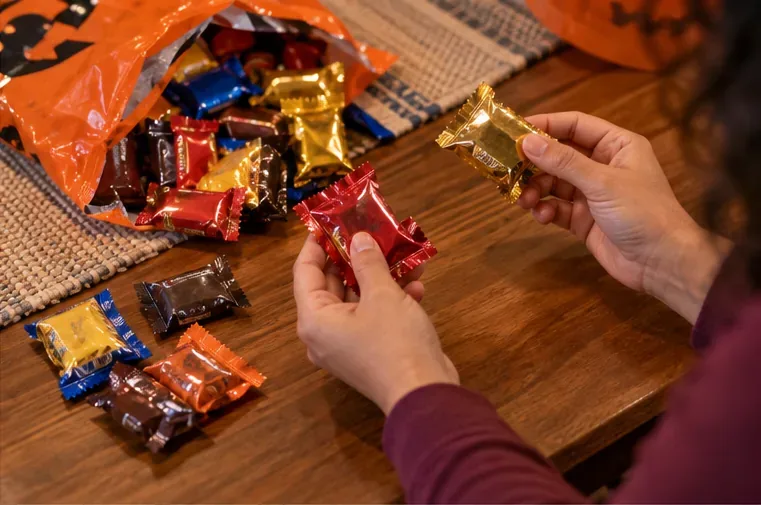
A caregiver pauses to check a wrapped Halloween treat before deciding whether it fits the child’s allergy plan.
Does “may contain” mean a candy definitely has the allergen?
No. Warnings such as “may contain [allergen]” or “made in a facility that also processes [allergen]” are voluntary advisory statements in the United States. They are used to alert consumers to possible cross-contact: an allergen may get into a food unintentionally through shared equipment, a production line, or other manufacturing conditions. The warning does not tell you how much allergen might be present, and its absence is not a guarantee that cross-contact is impossible. The FDA has not established threshold levels for allergens.
For a child with a diagnosed allergy, follow the child’s written plan and the allergist’s advice about precautionary statements. If the child’s plan says to avoid a particular allergen and the candy has a matching advisory warning, do not treat the warning as harmless simply because the allergen is not listed as an intentional ingredient. If you are unsure how the plan applies, choose a different treat and ask the clinician later.
Can I rely on last year’s candy or the full-size version?
Check again every year—and check the miniature candy itself or the original multipack label that clearly belongs to it. Manufacturers can change recipes, suppliers, facilities, or packaging. A “fun-size,” mini, or bite-size piece may have different ingredients or production conditions than the full-size version. Some small pieces may not have a full ingredient panel on the individual wrapper, so keep the original outer package. If loose candy is separated from its package and you cannot identify the exact product and label with confidence, set it aside for a non-food swap.
Do not use a general online list of “safe Halloween candy” as clearance for a particular piece. The exact product, size, market, and package matter, and labels can change. For a product with an unclear or incomplete label, use the manufacturer contact information on the package. Until you can verify the answer, offer another option.
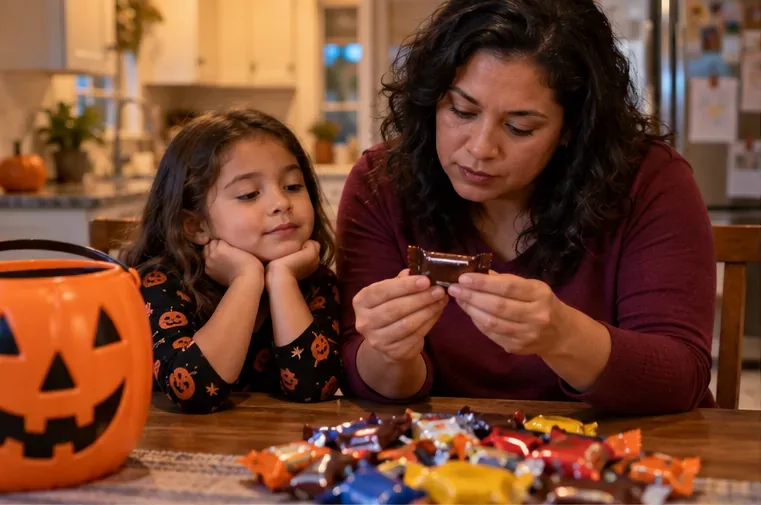
Miniature pieces can differ from full-size candy, so check the ingredients for the exact size and product.
What treats are easier to offer at a party or front door?
Non-food treats avoid food ingredients altogether and can make an event more welcoming. Consider stickers, pencils, small notebooks, glow bracelets, bubbles, or age-appropriate novelty toys. FARE’s Teal Pumpkin Project invites households to signal that non-food choices are available with a teal pumpkin or sign. A teal pumpkin indicates an option; it does not certify that food treats are allergen-free.
If you offer both candy and toys, keep them in separate bowls and let each child choose. Keep candy in its original sealed package until it is handed out. Wash hands and clean the surface before arranging treats, and avoid letting shared scoops or bowls touch individually wrapped candy. Ask an event organizer how food will be handled, and whether a child can bring a known safe treat from home. Do not promise that a treat is “allergy-free” unless the family’s care team has confirmed it is suitable for that child.
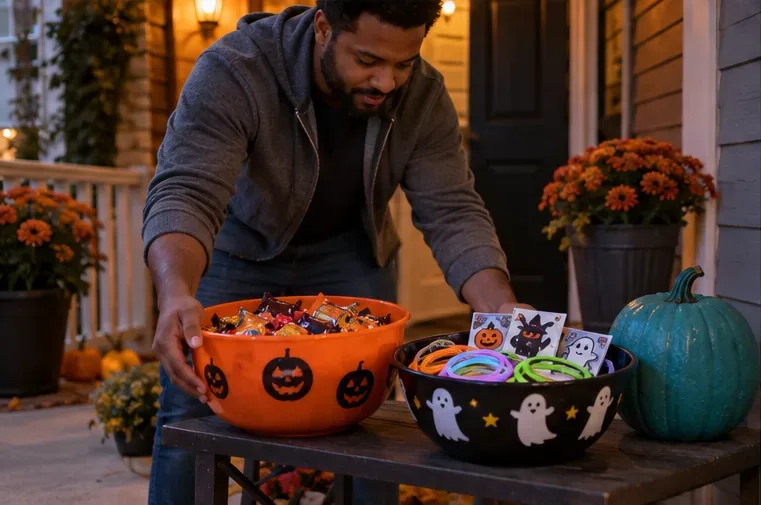
Separate bowls let trick-or-treaters choose a non-food item without mixing it with candy.
How can we plan trick-or-treating without eating an unknown piece?
Agree on the plan before leaving home. A simple rule is to wait until an adult can inspect each food treat; do not eat candy while walking between houses or accept unwrapped homemade food unless the child’s allergy team has specifically approved it. Bring a known safe snack or treat so the child has something to enjoy during the outing. Decide in advance whether the child will trade uncertain candy for a small toy or a preferred safe treat at home.
Carry the child’s prescribed epinephrine auto-injector and emergency care plan, and make sure the accompanying adult knows where they are and how to follow the plan. If the child is trick-or-treating with another caregiver, share the specific allergy, the emergency instructions, and your contact information. Do not rely on the child to identify every ingredient or manage an emergency alone.
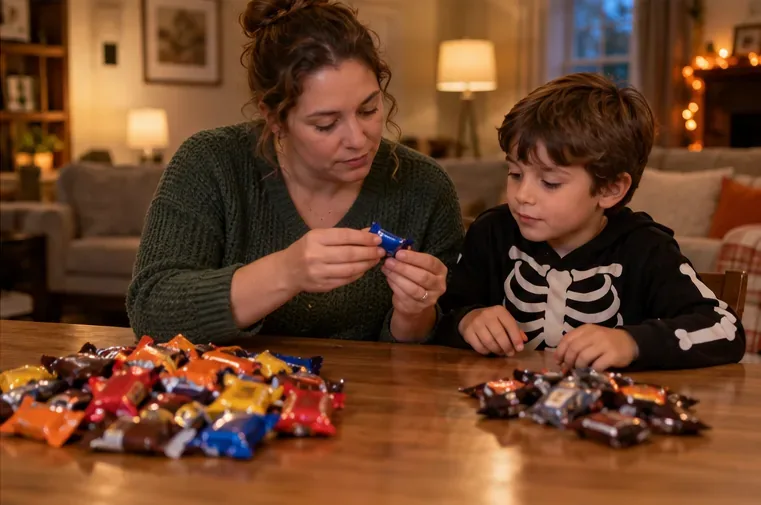
Sorting the haul with a trusted adult gives the family time to inspect labels before any candy is eaten.
What if symptoms start after a treat?
Follow the child’s individualized emergency plan. Food-allergy reactions can range from hives or swelling to breathing difficulty, throat symptoms, dizziness, or collapse; symptoms and severity can vary. If the plan calls for epinephrine, use the prescribed auto-injector promptly as directed and call 911 for suspected anaphylaxis. Do not wait to see whether symptoms progress or rely on an antihistamine in place of prescribed epinephrine. If you are uncertain whether a reaction is serious, use the action plan and get urgent medical help.
After the event, review any reaction with the child’s health care professional, even if symptoms improved. Keep the emergency plan current, check that prescribed medication is not expired, and make sure other caregivers know how to use it.
Quick checklist before Halloween night
Read the full ingredient list and “Contains” statement on the exact candy package.
Check the mini or fun-size version separately; do not rely on last year’s label or a full-size recipe.
Set aside unwrapped, homemade, unidentifiable, or insufficiently labeled treats unless the family’s clinician has advised otherwise.
Agree on a no-eating-until-checked plan and bring a safe alternative.
Pack prescribed epinephrine and the child’s emergency plan; brief every accompanying adult.
For parties or handouts, provide a separate non-food option and keep food treats sealed.
These steps reduce avoidable uncertainty, but no general candy list or label-reading shortcut can guarantee safety for every child. The child’s own allergist and written plan should guide decisions about specific foods and advisory warnings. This article reflects U.S. FDA, CDC, and FARE guidance reviewed on September 28, 2026.