Home
» Knowledge
»
How to Prepare Questions Before You Read a Medical Test Report
How to Prepare Questions Before You Read a Medical Test Report
Before opening a medical test report, write down what you need to understand: why the test was ordered, what the report can show, what it cannot establish by itself, and what happens next. A flagged result can be unsettling, but one number or phrase rarely tells the whole story. The meaning depends on the type of test and your health history, symptoms, examination, and sometimes other test results. This guide helps you prepare questions; it cannot interpret or diagnose an individual report.
What should you know before reading the report?
“Medical test report” can mean a lab result, imaging report, pathology report, genetic test, or another kind of result. They use different terms and answer different questions. For example, some lab reports list a reference range, while an imaging report may describe findings in words. Do not apply a lab reference-range rule to a scan or pathology report. Ask the ordering clinician to explain the report type and its limits.
MedlinePlus explains that lab results are only one part of a health assessment; clinicians interpret them alongside a person’s history, examination, and other information. A result in a patient portal may be available before a clinician has discussed it with you. Availability alone does not tell you how urgent it is or what it means. See MedlinePlus guidance on understanding lab results.
How can you prepare in four steps?
1. Gather the right report and the reason for the test
Confirm that the report is yours and note the test name, collection or exam date, ordering office, and whether the document is labeled preliminary, final, or amended, if that status is shown. If several results arrived together, list them so you can ask about each one. You do not need to decode every abbreviation before speaking with your clinician.
An adult organizes several report pages in a folder before a medical appointment.
Write one sentence about what you understand the test was meant to check. Then ask: “What question was this test ordered to answer?” “Was it meant to screen, monitor, help diagnose, or guide treatment?” “What can this test not tell us on its own?” These questions help set a useful frame before you focus on a flagged line.
2. Bring the context that may affect interpretation
Make a brief note of the symptoms or change that led to testing, when it began, and whether it has improved or worsened. Bring a current medication and supplement list, relevant health conditions, and earlier reports if you have them. Note test-specific preparation details, such as fasting or a missed instruction, but do not assume every factor applies to every test.
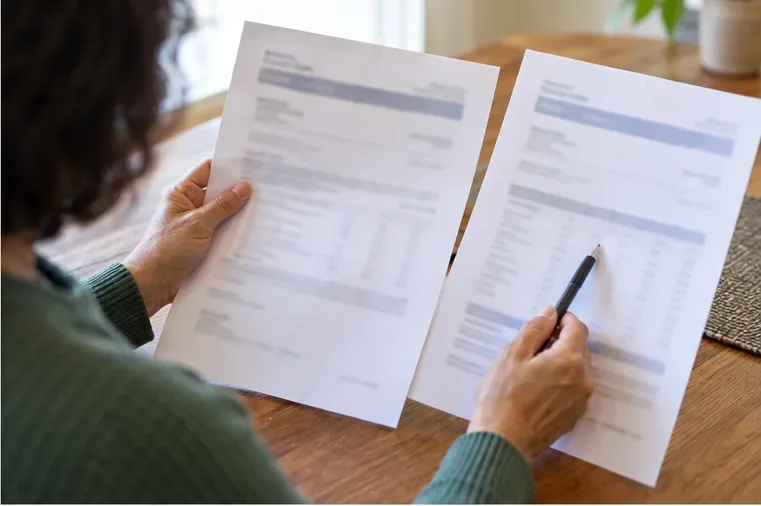
Reviewing two report pages can help a patient ask whether results are meaningfully different over time.
For some lab tests, medicines, supplements, food or drink, exercise, menstrual timing, and whether preparation instructions were followed can affect results. This is test-dependent, not a reason to dismiss a finding. MedlinePlus also notes that laboratories may use different methods and reference ranges, so results from separate labs may not be directly comparable. Ask: “Which details about my health or preparation matter for this test?” and “Should we compare it with a previous result from the same lab?”
3. Choose a few questions that matter most
Appointments have limited time. Write your questions in priority order, then mark the top three or four you most want answered. A simple structure is to ask about the finding, its meaning in context, and the next step.
Writing questions while reviewing medical papers and current medicines can help keep the discussion focused.
About the report: “Which result or finding should we focus on first?” “What does this term mean in plain language?”
About context: “How does this fit with my symptoms and health history?” “Could timing, preparation, or a medicine have affected it?”
About certainty: “Does this result answer the original question, or is it one clue?” “Is it conclusive, uncertain, or still pending?” “What other information would change the interpretation?”
About action: “Do I need another test, treatment, or a change in follow-up?” “How soon should that happen?” “What should I watch for while I wait?”
About communication: “Who will contact me about any remaining results?” “If I do not hear by a certain date, whom should I call?”
The Agency for Healthcare Research and Quality encourages patients to prepare questions for appointments. Its Questions Are the Answer resources include a question-building tool. Use a paper list, a secure notes app, or the clinic’s approved portal—whichever you can easily bring up during the visit.
4. Plan how you will discuss and record the answers
If it would help, invite a trusted support person to listen, take notes, or help you remember the plan. Ask the clinic in advance about an interpreter or an accessible format if needed. At the appointment, start with your top-priority question and request plain-language explanations. If you hear unfamiliar words, ask the clinician to define them or write them down.
A patient reviews a report with a clinician and can ask about its meaning and next steps.
Before leaving, repeat back the plan in your own words: which result needs follow-up, who is responsible for contacting you, when you should expect that contact, and whom to call if it does not happen. NIH guidance recommends writing questions before a visit, bringing a support person if useful, and taking notes or asking someone to take them. Read NIH tips for talking with your health care provider.
Which common assumptions can mislead you?
“A result outside the range means I have a disease.” Not necessarily. MedlinePlus notes that healthy people can sometimes have values outside a reference range, and a clinician considers other information. Action: Ask whether the finding is significant for you and what factors could explain it.
“A result inside the range proves that nothing is wrong.” A reference-range result is not a guarantee of health; symptoms or other findings may still call for follow-up. Action: Ask whether the test answers your original concern and whether any next step is needed.
“I can compare my number with a range I found online or with a result from another lab.” Different methods, units, and reference ranges can make that comparison unreliable. Action: Use the range printed on your own report and ask the clinician how to compare trends.
“A report in my portal is already a complete explanation.” A portal can display data without the clinical context or discussion. Some reports are preliminary or use specialized terms. Action: Ask who will explain the final result and when; do not treat a portal label as a diagnosis.
These points are especially relevant to common laboratory reports. Imaging, pathology, genetic, and other specialized reports may have different conventions and follow-up pathways. The report itself and your clinician’s explanation are needed to know which rules apply.
When should you contact someone promptly?
Do not wait for a routine appointment if the report or a message from the lab or clinic explicitly says “critical,” “urgent,” or instructs you to call now. Use the contact information in the message or on your official patient portal, and ask what action and timing are required. A routine high/low flag is not automatically the same as a critical result, but only the responsible clinical team can explain the specific report.
If you have severe or rapidly worsening symptoms, seek urgent medical care rather than waiting to understand a report. For a potentially life-threatening emergency in the United States, call 911. If you are unsure whether a result needs same-day follow-up, contact the ordering clinician’s office and ask; do not guess based on a color, asterisk, or search result online. If the clinic is closed, use the after-hours instructions it provided.
A short checklist before you open the report
I have the correct report, its date, and the name of the ordering clinician.
I know, or have written down, why the test was ordered.
I have noted relevant symptoms, medicines, supplements, preparation details, and prior results.
I have prioritized a few questions about meaning, uncertainty, and next steps.
I know whom to contact if a result is marked urgent or if the report is not explained.
Preparation is not about self-diagnosing from a report. It is about helping your clinician connect the result to the question that prompted testing and making sure you leave with a clear follow-up plan. If something is still uncertain, ask what is known now, what remains unknown, and when you should expect the next update.