Home
» Functional foods
»
How to Tell If a Supplement Dose May Be Too High—Even When It Says ‘Natural’
How to Tell If a Supplement Dose May Be Too High—Even When It Says ‘Natural’
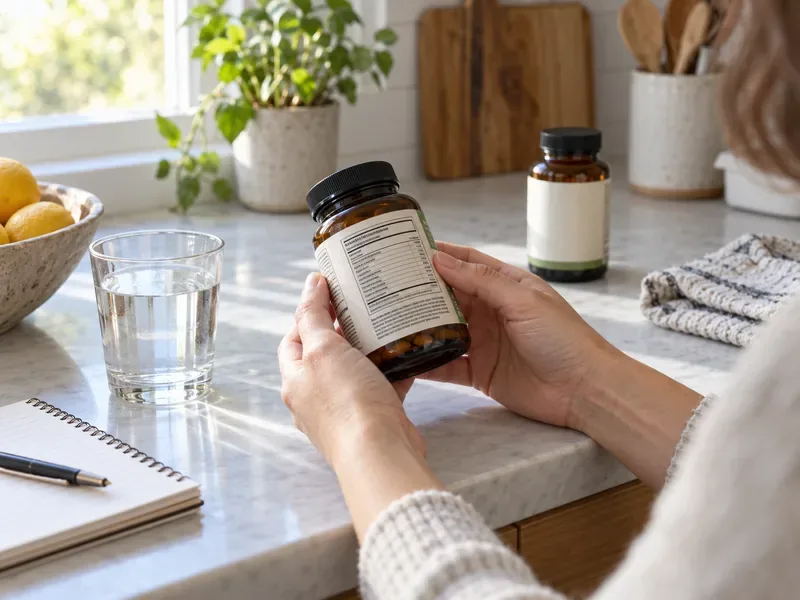
An adult checks a supplement label beside water and a notebook before reviewing the serving size and ingredients.
“Natural” does not tell you whether a supplement dose is safe. The more useful checks are the amount in each serving, how many servings you actually take, overlapping ingredients in other products, and whether your medicines or health conditions change the risk. Symptoms can be a clue, but they cannot identify an ingredient or prove that a dose is too high. If you suspect an overdose, a serious reaction, or a dangerous interaction, get professional help rather than trying to diagnose it from a label.
This guide summarizes U.S. clinical and public-health guidance checked September 30, 2026. It is general information, not a personal diagnosis or dosing recommendation.
Start with the label, not the word “natural”
On a U.S. Supplement Facts panel, find the serving size, the amount of each dietary ingredient per serving, and the directions. Serving size is not always one capsule or one scoop. If a serving is two capsules and you take two servings, you have taken twice the listed amount. Also check the other products you use: a multivitamin, electrolyte powder, fortified drink, and single-nutrient capsule can all contribute the same nutrient.
For example, someone might take a multivitamin plus a separate vitamin D product without noticing that both contain vitamin D. Add the amounts from the labels and note the units (micrograms or IU); do not assume that a larger number means a better result. The NIH Office of Dietary Supplements advises people to check labels and avoid doubling up unless a health professional has recommended it. Its supplement FAQ explains that some nutrients can be harmful above their upper limits.
“Natural” is not a dose, a purity test, or an individual safety guarantee. The FDA says natural products can still cause harm, and dietary supplements are not FDA-approved for safety and effectiveness before they are sold. The agency’s overview of dietary supplements describes what labels must list and how its oversight works. A label claim or a Supplement Facts panel cannot tell you by itself whether a product is appropriate for your particular situation.
What a “too high” dose means—and what it does not
For many vitamins and minerals, experts have set a tolerable upper intake level (UL): the highest average daily intake expected to pose little risk for most healthy people in a specific age group. A UL is not a recommended target, a personal prescription, or a sharp line where poisoning suddenly begins. Going above it does not prove that harm has occurred; staying below it does not guarantee safety for a person with a relevant condition, a medicine interaction, or unusual sensitivity. A clinician may sometimes recommend a higher dose for a limited time and monitor it.
Different nutrients have different limits, and the calculation may include food as well as supplements. The rule can also differ by ingredient form. For adults, NIH lists a UL of 4,000 IU (100 micrograms) of vitamin D per day from all sources. Its vitamin D fact sheet notes that a health care provider may recommend more temporarily to treat deficiency. By contrast, the adult UL for magnesium applies to magnesium from supplements and medicines, not naturally occurring magnesium in food; the NIH magnesium fact sheet sets it at 350 mg per day for adults. These examples are reference points, not instructions to start, stop, or adjust a product.
Age matters: children have different limits and are more vulnerable to accidental ingestion. Pregnancy, breastfeeding, kidney or liver problems, surgery, and prescription medicines can also change the risk. Some herbs affect how medicines work, even when the supplement dose follows its label. NCCIH advises discussing supplements with a health professional, especially when you use medicines or have a health condition; see its guidance on using dietary supplements wisely.
Common clues versus red flags
A symptom after starting a supplement deserves attention, but symptoms are not a home test for toxicity. Nausea, loose stools, stomach cramps, headache, flushing, or trouble sleeping can have many explanations: the ingredient itself, the amount, taking it on an empty stomach, another product, a medicine interaction, or an unrelated illness. For one specific example, NIH says high supplemental magnesium can cause diarrhea, nausea, and abdominal cramping. That pattern may prompt a dose and product review; it does not establish the cause for any one person.
Timing can help you explain the situation to a clinician: when you started, when you take it, when symptoms began, whether you changed the serving, and whether you take other products. Do not use symptom severity alone to estimate how much was absorbed, and do not wait for symptoms after a possible large accidental ingestion.
What you notice
Useful next step
Mild, short-lived stomach upset after a new nonprescription product
Check the ingredient, serving size, and duplicate products. Ask a pharmacist or clinician whether to pause or change it, particularly if symptoms recur.
Symptoms that persist, worsen, or begin after a dose increase
Contact a health professional promptly. Bring the container or a clear label photo and a list of medicines and supplements.
Possible overdose, unknown amount, multiple products, or a child’s ingestion
Contact Poison Control or a local poison center now, even if the person feels well. In the United States, call 1-800-222-1222 or use Poison Control.
Trouble breathing, collapse, seizure, inability to wake, or severe swelling of the face or tongue
Call 911 in the United States or your local emergency number immediately.
For suspected exposure, U.S. Poison Control says not to wait for symptoms. Its urgent-help guidance advises calling 911 for collapse, a seizure, trouble breathing, or inability to wake the person. Use local emergency and poison-center services outside the United States.
A practical label check to take to a pharmacist
Photograph the front label and the full Supplement Facts panel, including serving size and directions.
Write down the exact amount and time taken, including any extra or missed servings.
List other supplements, fortified drinks, medicines, and recent dose changes; include the ingredient forms and units.
Note when symptoms began and what changed, without assuming the supplement caused them.
Ask whether the amount is appropriate for your age, health conditions, medicines, and reason for taking it. Do not stop a prescribed medicine on your own.
If a health problem may be related to a supplement, contact a health professional. The FDA also accepts adverse-event reports, including reports when a person is unsure the product caused the problem, through its dietary supplement questions and answers page.
The takeaway
Judge a supplement by its ingredients and total dose, not by “natural” on the package. Compare the amount you actually take with reliable, age-specific guidance; account for overlapping products and food where relevant; and remember that upper limits are population guidance, not personal clearance. Mild symptoms can have several causes, while breathing problems, collapse, seizures, inability to wake, or a suspected overdose call for urgent help. A clinician or pharmacist can assess the label and your medication list without treating symptoms as a diagnosis.