Home
» First year of life
»
A Low-Stress Way to Track Baby Feeding, Sleep and Diapers Without Logging Every Minute
A Low-Stress Way to Track Baby Feeding, Sleep and Diapers Without Logging Every Minute
You do not need a minute-by-minute record of your baby's day to notice useful patterns. For most healthy infants, a short log of feeding events, wet diapers, notable stools, sleep blocks and unusual symptoms is enough to support everyday caregiving and give a pediatric clinician useful context when questions come up.
The goal is not to produce a perfect dataset. It is to answer practical questions: Is the baby feeding regularly? Are wet diapers continuing? Is sleep changing in a way that fits the baby's age? Is there a sudden departure from the baby's usual pattern? And are there any warning signs that should be evaluated rather than merely logged?
This approach is for general organization, not diagnosis. Premature babies, babies with medical conditions, infants who are not gaining weight as expected, or families following a clinician-directed feeding plan may need more specific tracking.
The minimum useful log
What to track
What to write down
What you usually do not need
Feeds
Approximate time, breast/bottle/solid food, and bottle amount if known; optionally note an unusual feed
Every pause, burp, latch change or exact minute of sucking unless a clinician asks
Wet diapers
A simple daily tally
Exact urine volume or the exact minute of every change
Stools
Count only when useful, plus unusual color, blood, marked diarrhea or a major change
Detailed descriptions of every normal stool
Sleep
Rough nap and overnight sleep blocks if sleep is a concern
Every brief stirring, grunt or minute awake
Symptoms
Fever, vomiting, breathing difficulty, unusual sleepiness, poor feeding or a clear behavior change
Normal day-to-day quirks that do not affect feeding, hydration or alertness
A practical rule is to record an event or meaningful change, not every second surrounding it. If the log takes more time than the caregiving itself, it is probably collecting more detail than you need.
A feed can be logged as one event: approximate time, feeding method and the amount offered or taken when that information is available.
Feeding: track opportunities and trends, not stopwatch precision
The American Academy of Pediatrics (AAP) emphasizes responsive feeding for most healthy, full-term babies: parents should watch hunger and fullness cues rather than rely only on the clock. Its current parent guidance notes that feeding patterns vary between babies and change as infants grow. AAP HealthyChildren: How Often and How Much Should Your Baby Eat?
For a log, that means the most useful entries are usually simple:
Breastfeeding: approximate start time and, if helpful, which side was started first. You generally do not need to time every active suck unless a lactation professional or pediatric clinician asks you to.
Bottle-feeding: approximate time and amount taken. The amount can be more useful than whether the feed lasted 14 versus 19 minutes.
Mixed feeding: label the type of feed so the overall 24-hour pattern is easy to see.
Older infants eating solids: record new foods or unusual reactions when relevant, rather than cataloging every spoonful.
AAP guidance notes that newborns often feed frequently, and that individual babies differ. The exact number of feeds is therefore less useful by itself than the combination of feeding behavior, growth and diaper output. AAP feeding guidance
What is a normal variation?
Cluster feeding, a temporarily shorter interval between feeds, or a longer feed than usual can occur without indicating a problem. Babies may also feed differently during growth spurts, illness, travel or developmental transitions. The useful question is whether the baby is still feeding effectively overall and maintaining expected hydration and growth.
When should feeding changes move from “log it” to “call someone”?
A sudden change matters more than a single odd feed. The AAP advises contacting a clinician when a newborn is unusually difficult to wake, does not wake for feeds, seems too tired or uninterested to eat, or has an abrupt change in feeding behavior. AAP HealthyChildren: Common Conditions in Newborns
Action: if feeding has clearly dropped off, note when the change began, the last few feeds and the recent wet-diaper count. Those three facts are usually more useful than a long minute-by-minute history.
Diapers: a daily count is usually more useful than a timeline
Wet diapers are one of the simplest home clues to hydration. You do not need to record 7:42 a.m. versus 8:03 a.m.; a tally across the day is generally more practical.
A simple wet-diaper tally can show whether urine output is continuing without requiring parents to timestamp every change.
The AAP lists decreased urination as a warning sign of dehydration. Its dehydration guidance notes that fewer than six wet diapers per day in an infant can be a sign of mild to moderate dehydration, while very low urine output can occur with severe dehydration. These numbers need context because urine output varies with age, feeding method and the first days after birth. AAP HealthyChildren: Signs of Dehydration in Infants & Children
For a newborn in the first days of life, the expected pattern changes quickly. Your baby's own pediatrician or maternity team may give age-specific targets, especially if breastfeeding is still being established or weight is being monitored.
What about stools?
Stool frequency can vary substantially, especially as feeding patterns change. A daily tally can be useful in the newborn period, during diarrhea, constipation concerns or a feeding evaluation, but many families do not need to document every normal bowel movement indefinitely.
Instead, record what would change the conversation with a clinician: blood, black stool after the newborn meconium period, pale or white stool, persistent watery diarrhea, repeated vomiting with reduced intake, or a clear abrupt change associated with illness.
Action: keep one diaper count for the whole day and add a short note only when something is meaningfully different. This preserves the signal without turning every change into paperwork.
Sleep: track blocks when you have a question, not every stirring
Infant sleep is naturally fragmented, especially in early infancy. AAP parent guidance notes that newborns do not yet have regular sleep cycles and may sleep for short stretches around the clock. AAP HealthyChildren: Getting Your Baby to Sleep
If sleep is not currently a problem, you may not need a sleep log at all. If you are trying to understand a pattern, use broad blocks such as “9:30–10:20 nap” or “asleep around 8:15, woke to feed around 11:30.” Do not feel obligated to record every brief noise, movement or partial waking.
For sleep, broad sleep blocks can be enough. Safe-sleep setup matters more than producing a perfectly detailed sleep record.
Keep tracking separate from safe-sleep decisions
A log should never encourage unsafe sleep just to preserve a schedule. The Centers for Disease Control and Prevention (CDC), supporting the AAP's 2022 safe-sleep recommendations, advises placing babies on their backs for every sleep on a firm, flat sleep surface and keeping soft bedding out of the sleep area. The CDC page was last updated September 17, 2024. CDC: Providing Care for Babies to Sleep Safely
Action: if tracking sleep starts to tempt you to keep a baby asleep in a car seat, swing, sofa or other place that is not a recommended sleep surface, stop tracking and move the baby to an appropriate sleep space.
A one-page system that works for many families
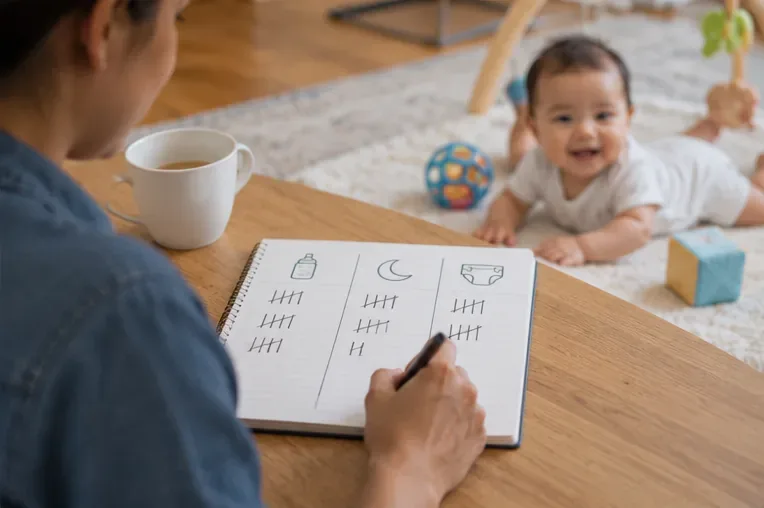
You can keep the entire day on one sheet of paper or one simple note on your phone. Three columns are often enough:
Feeds: time + type + amount if bottle-fed.
Diapers: one tally for wet diapers, optional tally for stools.
Sleep: rough blocks only if sleep is something you are actively evaluating.
Add a fourth line called “Anything unusual?” for fever, repeated vomiting, a rash, cough, breathing changes, unusual fussiness, marked sleepiness, feeding difficulty or medication given under medical guidance.
A low-detail tally of feeds, sleep blocks and diapers can reveal trends while leaving most of the day free for ordinary care.
Use a 24-hour summary instead of continuous surveillance
At the end of the day, ask four questions:
Did feeding look broadly like the baby's recent pattern?
Were wet diapers continuing at an expected rate for this baby?
Was the baby reasonably alert at times when awake?
Did anything change suddenly enough that I would want to mention it to a clinician?
If all four answers are reassuring, the detailed timestamps often matter less. If one answer is concerning, then the log has done its job: it has identified a pattern worth discussing.
What should you bring to a pediatric appointment?
You do not need weeks of raw data. A concise 24- to 72-hour snapshot is often easier to review, unless the clinician specifically asks for a longer record.
A useful summary might read:
“Eight feeds in the last 24 hours, mostly similar to usual; six wet diapers; two stools; three naps; woke twice overnight; no vomiting or fever.”
Or, if there is a concern:
“Feeds became much shorter yesterday afternoon; only three wet diapers since then; baby is sleepier than usual and harder to wake for feeds.”
The second summary immediately identifies why the pattern deserves attention without requiring anyone to scroll through 80 timestamped entries.
Red flags: when tracking is not enough
A tracker is a memory aid, not a safety net. Seek medical advice promptly when the baby's condition—not the spreadsheet—raises concern.
What you notice
Why it matters
What to do
Baby under 3 months with a rectal temperature of 100.4°F (38°C) or higher
Young infants with fever need prompt medical evaluation
Contact the pediatrician immediately or follow local urgent-care instructions
Hard to wake, very weak, unusually floppy, or unable to feed effectively
Can be a sign of significant illness
Seek urgent medical assessment
Trouble breathing, grunting with breaths, blue or gray lips/face
May indicate respiratory distress
Seek emergency care
Markedly fewer wet diapers, very dry mouth, no tears, sunken eyes or worsening lethargy
Can be associated with dehydration
Contact a clinician promptly; severe symptoms need urgent care
Repeated vomiting that prevents fluids from staying down, or green vomit
Can lead to dehydration or indicate a problem needing evaluation
Seek prompt medical advice; green vomit warrants urgent assessment
The AAP's updated parent guidance on fever states that a baby 3 months old or younger with a rectal temperature of 100.4°F (38°C) or higher should be evaluated promptly, even if no other symptoms are obvious. AAP HealthyChildren: Fever and Your Baby
AAP emergency guidance also highlights trouble breathing, extreme sleepiness or difficulty waking, persistent vomiting that prevents fluids from staying down, and signs of dehydration as reasons for urgent evaluation. AAP HealthyChildren: Urgent Care, ER or Pediatrician?
When should you track more detail?
More precise logging can be useful temporarily when there is a specific question, such as:
the pediatrician is evaluating poor weight gain;
a lactation consultant is assessing milk transfer or feeding technique;
the baby is premature or has a medical condition with a prescribed feeding schedule;
you are monitoring vomiting, diarrhea or possible dehydration;
you are trying to understand a short-term sleep problem before an appointment.
In those situations, ask the clinician exactly what they want recorded and for how many days. That prevents unnecessary effort and makes the record easier to interpret.
When should you track less?
Tracking is optional unless your baby's care team has asked for it. It is reasonable to simplify or stop when the baby is feeding and growing well, diaper output is reassuring, and the log is not answering a real question.
If recording becomes a source of anxiety, sleep loss or arguments between caregivers, reduce it to the smallest useful set of data: perhaps just feeds and wet diapers for a short period. A practical tracking system should support care, not compete with it.
A quick daily checklist
Record feeds as events, not minute-by-minute performance.
Tally wet diapers across the day.
Note stools only when frequency or appearance is relevant.
Track broad sleep blocks only if sleep is a current question.
Write down sudden changes in feeding, alertness, breathing, vomiting or temperature.
Follow safe-sleep guidance regardless of the desired schedule.
Escalate red flags rather than waiting to collect more data.
The best baby log is usually the one you can maintain without thinking about it constantly. A few consistent observations can show a useful trend; a perfect timeline is rarely the goal. When something feels clearly different from your baby's usual pattern—especially feeding, urination, breathing, alertness or fever—use the log to describe the change, but rely on a qualified clinician to decide what it means.