Fatty Meals and Upper-Abdominal Pain: Why It Can Start Hours Later
An important clarification in the Merck Manual’s October 2025 gallstone update changes how to read a food diary: a heavy meal can precede biliary pain, but fatty foods are not uniquely likely to trigger a gallstone attack. Fat may worsen indigestion for some people, and a large meal of any kind may coincide with gallbladder pain. So if discomfort starts hours after eating, timing is useful context—not a diagnosis.
An adult pauses at the table after a meal, with a hand resting over the upper abdomen.
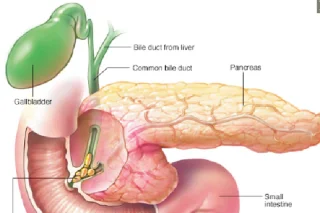
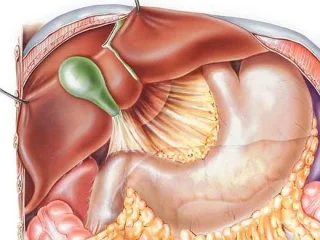
One possible explanation is that eating signals the gallbladder to release stored bile into the small intestine, where bile helps digest fats. If a gallstone temporarily blocks the gallbladder’s outlet, pressure can build and cause pain called biliary colic. The pain may begin after a meal, build over minutes, and last from several minutes to a few hours. But gallstones can also cause no symptoms, and fatty food is not a reliable way to identify them.
Why can the discomfort arrive later?
Digestion unfolds over time. The gallbladder stores bile and releases it after eating; the sensation of pain can begin when a stone obstructs a duct rather than at the first bite. Heavy meals may be followed by an attack, but symptoms can also arise at other times, including overnight. There is no dependable countdown from eating that tells you whether a gallstone is present.
The location and pattern are more informative than the meal alone. Biliary pain is often felt under the right ribs or in the upper middle abdomen. It can spread toward the back or right shoulder and may come with nausea or vomiting. A person may feel well between attacks. By contrast, burning, belching, and a sense of fullness soon after a meal fit indigestion more closely. These patterns overlap, so a clinician may need an exam and tests to sort them out.
Compare the common patterns
Pattern you notice
What it may fit
Practical next step
Steady pain under the right ribs or in the upper middle abdomen, sometimes spreading to the back or right shoulder; may last minutes to hours
Biliary colic is one possibility, especially if episodes recur after large meals. Fat content alone does not confirm it.
Arrange a medical appointment for recurring episodes. Seek urgent care if pain is severe, prolonged, or accompanied by red flags.
Burning or discomfort high in the abdomen, early fullness, bloating, or belching during or soon after eating
Indigestion (dyspepsia) or reflux may be more consistent. Rich or greasy food can worsen symptoms for some people.
Try a brief symptom-and-meal record and smaller portions; seek care if symptoms persist, change, or recur often.
Severe, constant pain that does not ease, repeated vomiting, fever or chills, or yellow skin or eyes
These can signal gallbladder inflammation, a blocked bile duct, pancreatitis, or another serious problem.
Get urgent medical assessment now. Do not wait to see whether another meal triggers it.
Upper-abdominal discomfort with chest pressure, shortness of breath, sweating, or pain in the jaw or arm
Some heart problems can feel like indigestion.
Call emergency services immediately, especially for new or severe symptoms.
Which food strategy is worth trying?
The best short-term choice depends on the pattern and the goal. A food adjustment can reduce a personal trigger or help you collect clearer observations, but it cannot confirm or rule out gallstones.
If the discomfort is mild and feels like fullness or burning
For a short trial, eat more slowly, choose smaller portions, and avoid only the foods that repeatedly seem to worsen symptoms. Note meal size, what you ate, when discomfort began, where it was, and how long it lasted. This approach is flexible and helps avoid unnecessary restrictions. If symptoms continue for more than a few days, keep returning, or are getting worse, contact a health professional rather than extending the experiment indefinitely.
If episodes are localized, steady, or recurring
Prioritize medical evaluation over a long elimination diet. A clinician may ask about the pain pattern, examine the abdomen, and order blood tests or imaging. Ultrasound is commonly used to look for gallstones; blood tests can help identify inflammation or problems involving the bile ducts, liver, or pancreas. Finding stones on a scan does not automatically prove they caused every digestive symptom, so the symptom pattern still matters.
While waiting for an appointment, some people choose smaller meals and temporarily reduce foods they have repeatedly linked with discomfort. The tradeoff is that relief may be incomplete and does not remove a stone or prevent every complication. Avoid fasting, crash dieting, or trying to lose weight rapidly; those are not safe ways to test whether the gallbladder is involved. Do not start a highly restrictive diet without professional advice.
When should you seek urgent care?
Get medical help right away if upper-abdominal pain lasts several hours, is severe or constant, or comes with repeated vomiting, fever, or chills. Yellowing of the skin or eyes, tea-colored urine, or unusually pale stools also needs prompt evaluation. These signs can occur when the gallbladder, bile ducts, liver, or pancreas is inflamed or blocked. If you feel faint, confused, very weak, or rapidly worse, use emergency services.
Call emergency services for chest pressure or pain with shortness of breath, sweating, faintness, or discomfort in the jaw, back, or arm. Do not assume that pain after a fatty meal is “just indigestion.”
For repeated but resolved episodes without urgent warning signs, schedule a timely appointment. Bring a short record of the pain’s location, start time, duration, intensity, meal size, and associated symptoms. This gives a clinician more useful evidence than labeling a food as the cause.
What the evidence can—and cannot—tell you
Official guidance describes gallbladder attacks as upper-right or upper-middle abdominal pain that can last for hours, and urgent symptoms include persistent pain, fever or chills, jaundice, dark urine, and pale stools. Updated clinical reference material also cautions that fatty food is not a specific trigger: a heavy meal may be followed by pain whether or not it is especially fatty. Indigestion can also follow greasy food, often with burning, fullness, bloating, or belching.
Because these symptoms overlap with ulcers, reflux, pancreatitis, and other conditions, a meal diary is a clue—not a diagnostic test. If the pain is recurrent, worsening, or unusual for you, ask a health professional to assess it. This article explains common patterns and care thresholds; it cannot diagnose the cause of an individual’s pain.