Home
» Sperm health
»
Can Fever, Hot Baths, or Recent Illness Temporarily Affect Sperm Quality?
Can Fever, Hot Baths, or Recent Illness Temporarily Affect Sperm Quality?
Yes. A fever, repeated hot-tub or very hot bath exposure, and some illnesses can temporarily affect semen quality. The effect is not the same for everyone, and a single exposure does not automatically mean fertility is impaired. The most useful way to think about the issue is in terms of timing, intensity, repetition, and whether there are other symptoms or fertility concerns.
Current clinical guidance does not diagnose fertility from one symptom or one semen sample. The AUA/ASRM male infertility guideline recommends a reproductive history plus one or more semen analyses as part of the initial male evaluation, and notes that results matter most when several semen parameters are abnormal. The World Health Organization laboratory manual, 6th edition, published in 2021, remains a key reference for standardized semen testing and specifically notes that recent illness, particularly febrile illness, can influence ejaculate characteristics.
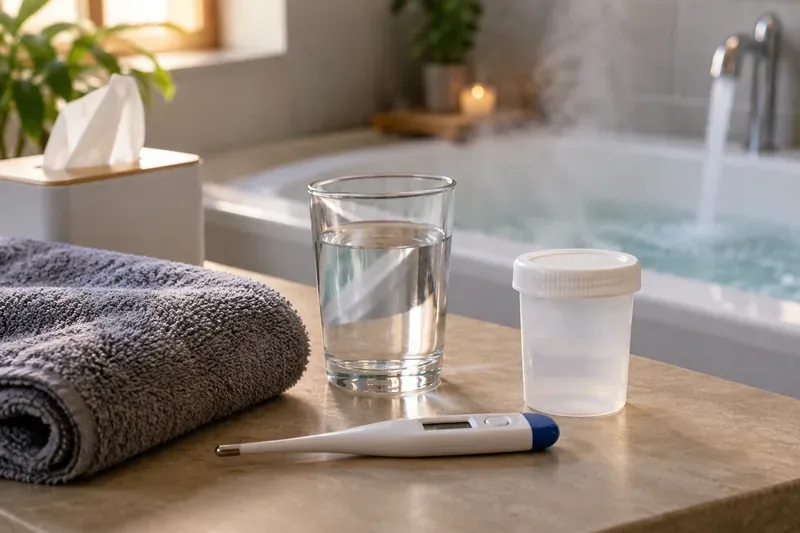
A thermometer and specimen cup beside a steaming bath illustrate two common short-term factors that may complicate interpretation of semen quality: recent fever and repeated heat exposure.
Why heat can matter to sperm production
The testes normally function at a temperature slightly below core body temperature. When testicular temperature rises repeatedly or for long enough, sperm production and maturation can be disturbed. That does not necessarily mean permanent damage. In many studied situations, changes have been reversible after the heat exposure stops.
Evidence is strongest for substantial or repeated heat exposure rather than an occasional warm shower or a brief bath. A small clinical study of men with infertility and regular hot-tub, whirlpool, or hot-bath exposure found that some participants had marked improvement in total motile sperm count after stopping wet-heat exposure. The study was small, so it cannot tell us exactly how much risk applies to any individual, but it supports reversibility in at least some men. The original study is available through PubMed.
An experimental study in healthy volunteers used repeated 43°C water-bath exposure to the testes and found reversible reductions in sperm concentration and motility during follow-up. That exposure was much more controlled and intense than ordinary bathing, so it should not be used to estimate the effect of a single hot bath. It does, however, show that repeated scrotal heating can alter semen parameters. See the original PubMed record.
Fever is a different kind of heat exposure
A fever raises core body temperature rather than warming the scrotum from the outside. This can temporarily interfere with developing sperm cells. Older prospective research following men through febrile episodes found lower sperm concentration after fever during certain stages of sperm development. The study was small, but its repeated-sample design supports the clinical practice of asking about fever when interpreting semen tests. The original study is indexed at PubMed.
Recent clinical laboratory guidance reflects this concern. Cambridge University Hospitals advises patients to report a raised temperature within the previous three months because it can affect sperm quality. Manchester University NHS Foundation Trust similarly notes that an illness causing a high temperature within the previous three to six months may influence sperm production or quality. These recommendations do not mean that every fever causes a clinically important fertility problem; they mean the timing should be considered when interpreting a result.
How do fever, hot baths, and non-fever illness compare?
Situation
What is reasonably supported
Practical tradeoff
One brief hot bath
Direct evidence of a meaningful fertility effect from a single ordinary exposure is limited.
Usually little reason to panic or cancel plans based on one event alone.
Frequent hot tubs, very hot baths, or repeated scrotal heat
Repeated heat exposure can reduce sperm concentration or motility in some men, and improvement may occur after exposure stops.
If fertility is a priority, reducing repeated heat for a few months is a low-cost precaution.
Fever from flu, COVID-19, or another infection
Fever can temporarily alter semen parameters, with effects sometimes appearing after the illness because sperm are developing over weeks.
If a semen test is abnormal soon afterward, the fever may be one factor to discuss before drawing conclusions.
Recent illness without fever
Effects vary by illness. Dehydration, inflammation, medications, reduced sexual activity, or direct involvement of the reproductive tract can matter.
Do not assume the illness explains an abnormal result; provide the full history to the clinician.
Illness with testicular pain or swelling
This is not the same as a routine viral illness. Conditions such as orchitis or epididymitis can require medical assessment.
Prioritize evaluation rather than waiting several months to see whether fertility changes resolve.
If you are trying to conceive now, should you stop?
For most people who had an uncomplicated fever that has resolved, there is no general clinical rule requiring them to stop trying to conceive for three months. A temporary change in semen quality is not the same as sterility, and conception may still occur naturally.
The tradeoff is mostly about probability and timing. If there is no time pressure, avoiding repeated high-heat exposure while the body recovers is reasonable. If age, treatment scheduling, or other fertility factors make time important, automatically delaying attempts may not be helpful. In that situation, continuing attempts while discussing the recent illness with a fertility clinician is often more practical than imposing a fixed waiting period.
A large prospective preconception study involving more than 3,000 couples found only weak inverse associations between recent fever or hot-bath use and fecundability, meaning the per-cycle probability of conception. The confidence intervals included little or no effect for several comparisons. That study is useful because it looked at pregnancy rather than semen parameters alone, but it was observational and relied partly on self-reported exposure. See the original study.
If you need a semen analysis soon, test now or wait?
Testing now may make sense when time matters
If a fertility workup is already underway, a semen analysis soon after illness can still provide useful information, especially when there are other reasons not to delay evaluation. Tell the laboratory or clinician about the fever, its approximate date, how high it was if known, and any medications taken. A result should be interpreted in that context.
Waiting may reduce uncertainty when the only concern is a recent fever
If there is no urgency and the main question is whether sperm quality has returned to baseline, waiting roughly three months before repeating an abnormal test is common practice because sperm production unfolds over a multi-week cycle. The NHS notes that a repeat semen analysis after an abnormal first test is commonly done at about three months. Cambridge University Hospitals also explains that a second analysis helps determine whether a poor result reflected a temporary factor such as illness, stress, medication, or sample collection.
That does not mean every abnormal result should simply be ignored for three months. Very low sperm counts, no sperm seen, or other concerning findings may prompt earlier specialist review. The AUA/ASRM guideline recommends evaluation by a male reproductive expert when semen parameters are abnormal.
What about saunas, heated seats, laptops, and tight underwear?
Not all sources of warmth have the same evidence. In the prospective preconception study noted above, hot baths or tubs showed a weak inverse association with fecundability, while sauna use, laptop-on-lap use, heated seats, sitting time, and tight underwear showed little association individually. That does not prove those exposures are harmless in every setting, but it argues against treating all forms of everyday warmth as equally important.
For someone actively trying to optimize sperm quality, the most defensible strategy is to focus on repeated, high-intensity heat that is easy to change: long hot-tub sessions, frequent very hot baths, or occupational heat exposure. You do not need to turn ordinary daily life into a temperature-control project.
What should you do after a fever or heat exposure?
Record the timing. Note when the fever or repeated heat exposure occurred. This can help interpret a semen test weeks later.
Resume normal recovery habits. Hydration, sleep, and treating the underlying illness appropriately matter more than unproven “sperm detox” products.
Reduce repeated high heat if fertility is a priority. Favor showers over very hot baths for a while, limit hot tubs, and avoid prolonged direct heating of the scrotum when practical.
Do not start testosterone to “boost” fertility. The AUA/ASRM guideline specifically warns that testosterone monotherapy should not be prescribed to men interested in current or future fertility because it can suppress sperm production.
Be cautious with supplements. The same guideline states that the clinical benefits of antioxidants and vitamin supplements for male infertility are of questionable utility, with inadequate evidence to recommend specific agents.
If a semen test is abnormal, look at the whole pattern. Count, motility, morphology, semen volume, collection conditions, abstinence interval, illness history, medications, and repeat testing may all matter.
When is recent illness more than a temporary fertility issue?
Fever alone does not tell you whether the testes are involved. Seek prompt medical assessment if you develop a new testicular lump, swelling, persistent aching, or a change in testicular size or feel. Sudden severe testicular pain is an emergency because conditions such as testicular torsion require rapid treatment. The NHS testicular pain guidance advises emergency care for sudden severe pain, pain with nausea or vomiting, or pain lasting more than an hour or continuing at rest.
Some infections can directly involve the testes. For example, the CDC notes that mumps can cause orchitis, or inflammation of the testicles, and that this may reduce testicular size and can temporarily reduce fertility. Testicular swelling during or after mumps therefore deserves medical attention rather than being treated as an ordinary post-fever fertility fluctuation.
When should fertility evaluation start?
Do not blame months of difficulty conceiving on one past fever without an evaluation. ASRM defines infertility broadly and recommends evaluation after 12 months of regular unprotected intercourse when the female partner is under 35, and after 6 months when she is 35 or older, with earlier evaluation when there are known risk factors. The ASRM infertility definition also emphasizes that diagnosis depends on history, age, physical findings, and testing rather than one semen value.
Bottom line
Fever and repeated high-heat exposure can temporarily reduce sperm quality, particularly sperm concentration or motility, but the size and duration of the effect vary. A single hot bath is not equivalent to repeated intense scrotal heating, and a temporary semen change is not the same as permanent infertility. If a semen analysis is abnormal soon after fever, tell the clinician and consider whether repeat testing after recovery is appropriate. If there is significant testicular pain, swelling, a lump, or prolonged difficulty conceiving, do not wait for heat-related changes to “wear off” before seeking evaluation.