Home
» Skin Care
»
How to Repair an Irritated Skin Barrier After Too Many Active Ingredients
How to Repair an Irritated Skin Barrier After Too Many Active Ingredients
When skin starts burning, stinging, peeling, feeling unusually tight, or turning red after you layer several active ingredients, the safest first goal is not to “treat harder.” It is to reduce further irritation and give the outer skin time to function normally again. This is often described as repairing the skin barrier, but that phrase is not a diagnosis. Similar symptoms can also come from irritant contact dermatitis, allergic contact dermatitis, eczema, rosacea, a medication reaction, or infection.
A useful outcome is therefore more specific than “my barrier is fixed.” You want skin that is progressively more comfortable, tolerates basic cleansing and moisturizing without significant burning, is shedding less, and is no longer becoming redder or more inflamed day by day. Once that pattern is stable, you can decide whether and how to restart active ingredients.
Guidance check: This article was reviewed against current American Academy of Dermatology (AAD), MedlinePlus, and U.S. Food and Drug Administration (FDA) information available in October 2026. It is general education, not a diagnosis or a substitute for individualized medical care.
What usually helps first: simplify the routine
Many common “active” products can irritate skin, especially when they are introduced too quickly or stacked together. Examples include topical retinoids or retinol, alpha hydroxy acids (AHAs), beta hydroxy acids (BHAs) such as salicylic acid, benzoyl peroxide, strong vitamin C formulas, exfoliating scrubs, and some acne combinations. The AAD notes that using several anti-aging products at once can irritate skin, and the FDA labeling for adapalene warns that irritation is more likely when more than one topical acne medication is used at the same time.
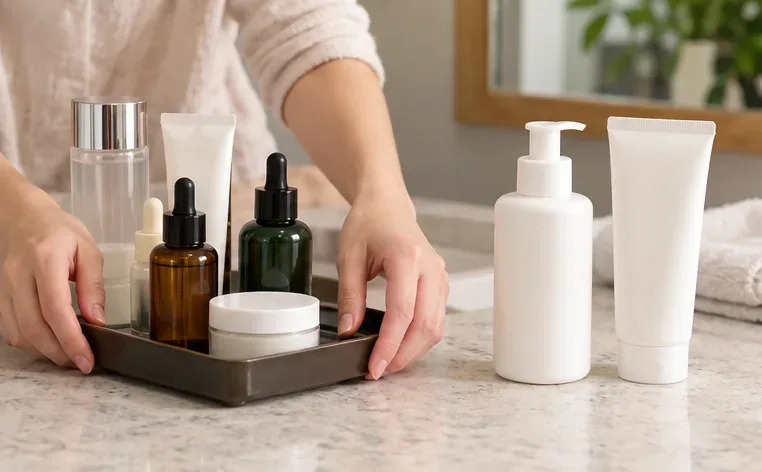
Step 1: Put potentially irritating actives aside temporarily and keep only the basic products your skin can tolerate.
1. Pause the nonessential products that sting, peel, or exfoliate
If a cosmetic active is clearly making your skin burn, sting, peel, or become redder, stop layering it on top of already irritated skin. The AAD advises stopping an anti-aging product that stings, burns, or tingles, while also noting that prescription products are different: if the product was prescribed, ask the prescribing clinician how to adjust it rather than assuming you should stop it indefinitely.
During the reset, skip scrubs, cleansing brushes, peels, toners with high alcohol content, fragranced products, and “extra” masks or spot treatments. More ingredients create more opportunities for continued irritation or allergy. “Natural,” “clean,” and botanical products are not automatically gentler; the AAD notes that skin-care products themselves are common causes of contact dermatitis.
2. Clean gently and only as much as you need
Use lukewarm rather than hot water and a mild, fragrance-free cleanser. Apply it with your fingertips rather than a rough washcloth, scrub pad, or cleansing brush. For many people, cleansing once in the evening is enough during a short period of marked dryness or sensitivity, although sweat, sunscreen, makeup, or acne treatment may make a second wash useful. The AAD generally advises limiting face washing to twice daily and after sweating.
Step 2: Use lukewarm water and gentle fingertip cleansing; avoid scrubbing irritated or peeling skin.
What should moisturizer accomplish?
A moisturizer does not need to feel “active” to be useful. Its job is to reduce water loss, improve comfort, and provide a protective layer while irritated skin settles. AAD guidance for dry and eczema-prone skin favors fragrance-free creams or ointments over thin lotions when more occlusion is needed. Ingredients such as ceramides can help skin retain moisture, while petrolatum is a simple occlusive option that many people tolerate.
3. Apply a bland moisturizer to slightly damp skin
After cleansing, gently pat the skin so it is no longer dripping but is still slightly damp, then apply a fragrance-free cream or ointment. Reapply when the skin feels dry. If you are acne-prone, a product labeled non-comedogenic may be more comfortable for regular facial use, but “non-comedogenic” does not guarantee that a product cannot irritate you.
If even a simple moisturizer causes intense burning, swelling, hives, or a rapidly worsening rash, do not keep pushing through it. The issue may be more than routine dryness or over-exfoliation.
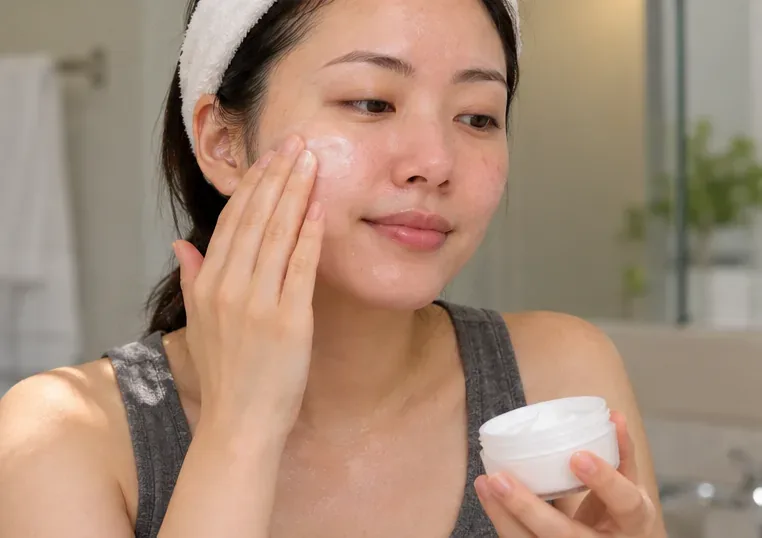
Step 3: Apply a simple fragrance-free cream or ointment after cleansing, while the skin is still slightly damp.
Do you still need sunscreen while the skin is irritated?
Yes, when you are outdoors or exposed to meaningful ultraviolet light. Irritated skin can be more uncomfortable in sun, and several acne and anti-aging actives increase sun sensitivity. The AAD recommends a broad-spectrum, water-resistant sunscreen with SPF 30 or higher. For sensitive skin, the AAD notes that mineral sunscreens containing zinc oxide, titanium dioxide, or both may be easier to tolerate for some people.
4. Protect the skin instead of trying to “treat” every mark immediately
Sun protection matters because inflammation can be followed by lingering discoloration, especially in deeper skin tones. If your usual sunscreen stings on compromised skin, consider shade, a hat, and sun-protective clothing while you test a gentler sunscreen. Do not replace sun protection with another exfoliating or brightening product while the skin is still reactive.
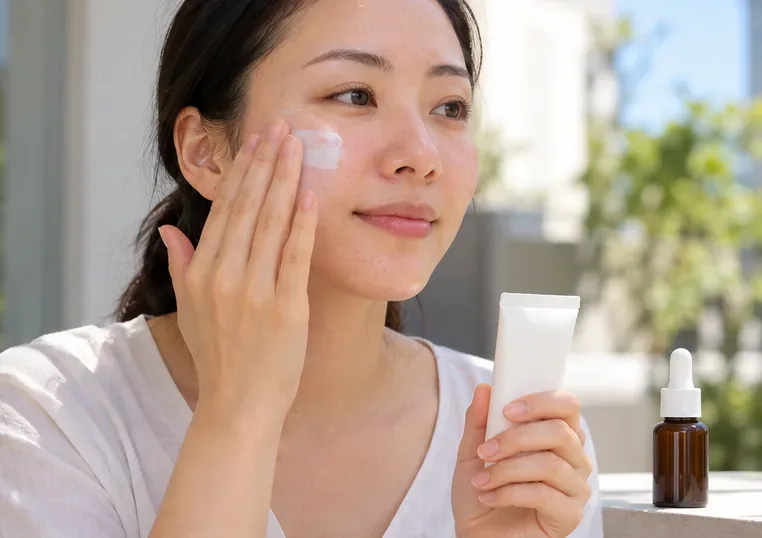
Step 4: Use broad-spectrum SPF 30 or higher when needed, choosing a formula your recovering skin can tolerate.
How do you know the routine is working?
Do not judge recovery only by how smooth the skin looks on one morning. Look for a trend over several days. Improvement is more convincing when multiple signs move in the same direction:
Washing no longer causes marked burning or prolonged stinging.
Tightness after cleansing is decreasing.
Peeling or flaking is becoming less extensive rather than spreading.
Redness is fading or at least no longer intensifying.
The skin is not developing new swollen, weeping, crusted, or blistered areas.
A simple moisturizer feels comfortable and does not trigger a new rash.
There is no universal number of days that proves a “barrier” has healed. Recovery depends on the irritant, how often it was used, your baseline skin condition, climate, other medications, and whether the problem is actually irritation rather than allergy or another skin disorder. MedlinePlus notes that contact dermatitis may take weeks to clear in some cases, which is one reason a rigid three-day or seven-day promise is not reliable.
When is it reasonable to restart an active ingredient?
Wait until the skin is calm enough that your basic routine is comfortable and the rash-like features are clearly resolving. Then restart only one nonessential active at a time. This gives you a realistic chance of identifying what your skin can tolerate.
Decision point
Better sign
Reason to wait or get advice
Cleansing
No significant burning with a gentle cleanser
Persistent stinging, raw areas, or worsening redness
Moisturizing
Plain moisturizer feels comfortable
Swelling, hives, blistering, or a new spreading rash
Peeling
Flaking is clearly decreasing
Cracking, bleeding, weeping, or crusting
Restarting an active
Skin has been stable on the basic routine
Symptoms are still changing rapidly or the cause is uncertain
When you do restart, use the lowest practical frequency rather than immediately returning to your previous schedule. For retinoids, the AAD describes strategies clinicians may use to reduce irritation, including a smaller amount, less frequent application, and moisturizer. FDA labeling for adapalene likewise states that irritation may be reduced by using it less often, using a moisturizer, or using only one topical acne medication at a time.
Do not assume those strategies apply identically to every prescription drug or cosmetic acid. Follow the product label and, for prescription treatment, your clinician’s instructions.
Common irritation versus warning signs
Mild redness, dryness, tightness, peeling, or stinging after overusing retinoids, acids, or acne treatments can fit ordinary irritation. But you cannot reliably diagnose the cause from symptoms alone. Allergic contact dermatitis can appear hours or days after exposure and may become increasingly itchy, swollen, or widespread. Infection can also develop in damaged skin.
Get prompt medical advice if you notice:
Severe pain, rapidly worsening redness, or substantial swelling.
Blisters, especially around the eyes, mouth, or genitals.
Yellow or green drainage, increasing warmth, red streaks, or fever.
A rash that keeps spreading despite stopping the suspected product.
Persistent symptoms that are not improving with a simple routine.
Repeated reactions to multiple products, where patch testing or another dermatologic evaluation may be useful.
Seek emergency care for trouble breathing, facial or throat swelling, faintness, or a sudden rapidly spreading rash, as these can occur with a serious allergic reaction.
What not to do while the skin is recovering
Do not exfoliate peeling skin to make it look smoother. Mechanical or chemical exfoliation can prolong irritation.
Do not add multiple “barrier repair” serums at once. A long ingredient list is not automatically better.
Do not use fragrance to mask the problem. Fragrance is a common contact allergen and irritant.
Do not interpret burning as proof that a product is working. The AAD specifically treats stinging and burning as signs of irritation for cosmetic anti-aging products.
Do not restart everything on the same night. If symptoms return, you will not know which product caused the problem.
A simple recovery checklist
Pause unnecessary retinoids, acids, scrubs, peels, and overlapping acne treatments if they are irritating the skin.
Use a mild, fragrance-free cleanser with lukewarm water and fingertips.
Apply a fragrance-free cream or ointment to slightly damp skin.
Use broad-spectrum SPF 30 or higher when outdoors, plus shade or protective clothing.
Track comfort, redness, peeling, swelling, and any drainage rather than relying on appearance alone.
Restart one active at a time only after the skin is clearly calmer.
Ask a clinician before changing a prescription regimen or if symptoms are severe, persistent, or unusual.
The main limit of at-home “barrier repair” is that it treats the skin gently without proving why the reaction happened. If the skin is not trending better, the safer next step is not a stronger routine; it is a clinical review that can distinguish simple irritation from allergy, eczema, rosacea, infection, or another condition that needs different treatment.