A useful diabetes sick-day log gives your care team a clear timeline of what is happening: glucose and ketone results, symptoms, medicines taken, and how much you can eat or drink. This five-step guide is for people with diabetes and anyone helping care for them. Use the sick-day plan your clinician gave you; this log supports that plan and does not replace medical advice.
Prerequisites
- Gather: a notebook or phone note, glucose meter or continuous glucose monitor (CGM), thermometer, medication list, and ketone testing supplies if your care plan calls for them.
- Time: about 5–10 minutes to set up; entries take a minute or two as you follow your care team’s monitoring schedule.
- Difficulty: Easy.
Step 1: Set up a dated timeline
Write the date and time symptoms began, the illness or concern (for example, fever, cough, nausea, or diarrhea), and your usual contact number for the diabetes care team. Leave space for repeated entries. Record the time beside every measurement, dose, symptom change, or call. A timeline helps clinicians distinguish a one-time result from a pattern.
Step 2: Record glucose readings and how they were measured
For each check, note the time, result, and units (usually mg/dL in the United States). Identify whether the result came from a finger-stick meter or a CGM. If you use a CGM, include notable alerts or trends and any finger-stick confirmation you made according to your device instructions or care plan. If a reading seems unexpected, note symptoms and context rather than silently replacing it. Follow your own clinician’s instructions for how often to check; CDC guidance says people may need more frequent checks while sick, and its general sick-day page advises checking every four hours.
Step 3: Add ketone results, when indicated
Write the time and result for urine or blood ketone checks, including the test type and the wording shown by the kit. Ketones are substances produced when the body breaks down fat for energy. CDC advises people with diabetes who are sick or whose glucose is 250 mg/dL or higher to check glucose every 4–6 hours and check urine ketones; follow your personal plan, since your clinician may give different instructions. CDC guidance on diabetic ketoacidosis.
Step 4: Log medicines, food, fluids, and symptoms
List each diabetes medicine taken, its dose, and time. Include any dose that was missed, delayed, vomited, or changed under instructions from your care team. Do not use the log to decide on your own to stop or change medicine. Note meals or snacks, whether you could keep them down, and fluids consumed; rough amounts are more helpful than “some.” Record temperature and, if requested by your clinician, daily weight. Add symptoms such as vomiting, diarrhea, pain, unusual thirst, frequent urination, or difficulty breathing, with a brief note about whether they are improving or worsening.
Step 5: Summarize the timeline for your care team
When you call, send or read the entries in chronological order. Start with when illness began and your current symptoms, then report the latest and highest or lowest glucose values, ketone results, medicines and doses, and ability to eat and drink. Finish with your specific question. For example: “Since 7 a.m. I’ve checked glucose at 7, 11, and 3; it was 184, 226, and 241 mg/dL. Urine ketones were negative at 3. I took my usual medicines as directed, drank about 24 ounces, and have vomited once. Should I follow any additional steps in my sick-day plan?” This is an illustrative format, not a treatment recommendation.
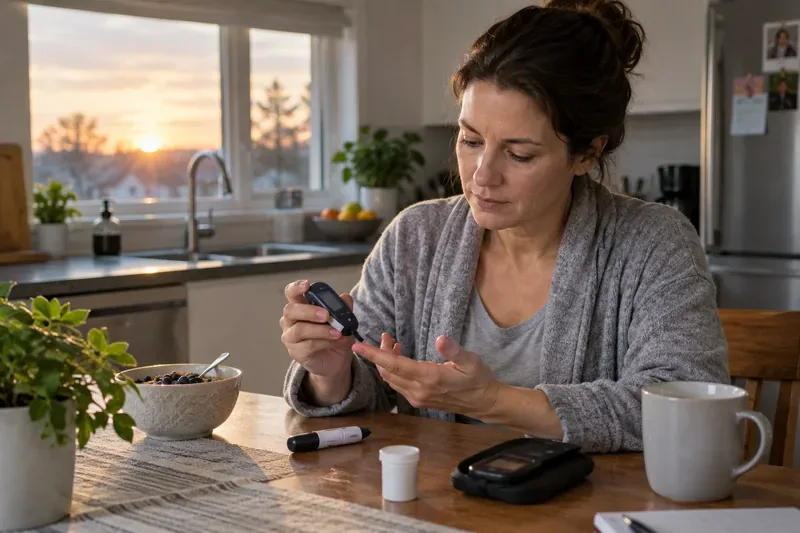
A simple home setup can keep sick-day notes and testing supplies together.
Troubleshooting
- You missed an entry: Leave it blank or mark it “not recorded.” Don’t guess at a number or time. Resume the log and tell the clinician where information is missing.
- Your CGM and finger-stick result differ: Record both values, their times, symptoms, and any action you took under your device directions. Ask your care team how to handle discrepancies; do not erase one reading.
- You feel too ill to keep logging: Ask a family member or caregiver to record readings and medicine times. If you are confused, severely weak, or struggling to breathe, prioritize getting help over completing the log.
Frequently asked questions
How often should I check glucose when I’m sick?
Follow your personal sick-day instructions. CDC’s general guidance recommends checking every four hours, while its DKA guidance describes checks every 4–6 hours for people who are sick or have glucose at least 250 mg/dL. Your clinician may tailor the schedule to your medicines and health situation.
What symptoms or readings need urgent help?
Seek emergency care or call 911 for trouble breathing, fruity-smelling breath, vomiting that prevents keeping food or liquids down, multiple possible DKA symptoms, or high ketones. CDC also advises emergency care if glucose stays at 300 mg/dL or above. Contact your care team promptly for individualized instructions. Do not delay emergency care to finish a log.
Can I use a phone app instead of paper?
Yes. A meter, CGM app, or written notebook can all help organize information. CDC notes that many meters save results and some use an app, while a written record is also an option. Make sure you can share the relevant times, units, symptoms, and medicines with your care team.
Sources: CDC: Managing Sick Days; CDC: Diabetic Ketoacidosis; CDC: Monitoring Your Blood Sugar.